
Core
Published reference6–7 PCF rigid fiberglass in one-piece or two-piece construction.
Project decisionConfirm construction, thickness and current product data.
ACC-U-SOUND · Rigid hanging baffle
HB suspends rigid, fabric-finished baffles from a QTS specialized bracket. One-piece and back-to-back constructions carry different published edge and thickness options.
HB product role
HB uses a 6–7 PCF rigid-fiberglass core and a factory-installed specialized hanging bracket for large open environments.
One-piece baffles are published with square edges. Back-to-back construction expands the edge choices and changes how the fabric returns at the panel joint. Suspension hardware beyond the QTS bracket is identified as contractor scope in the source specification.
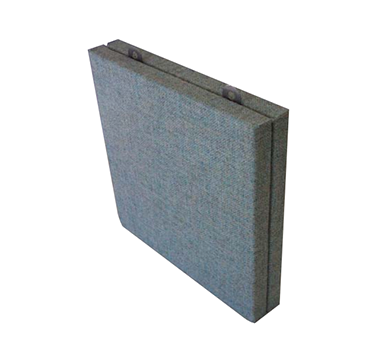
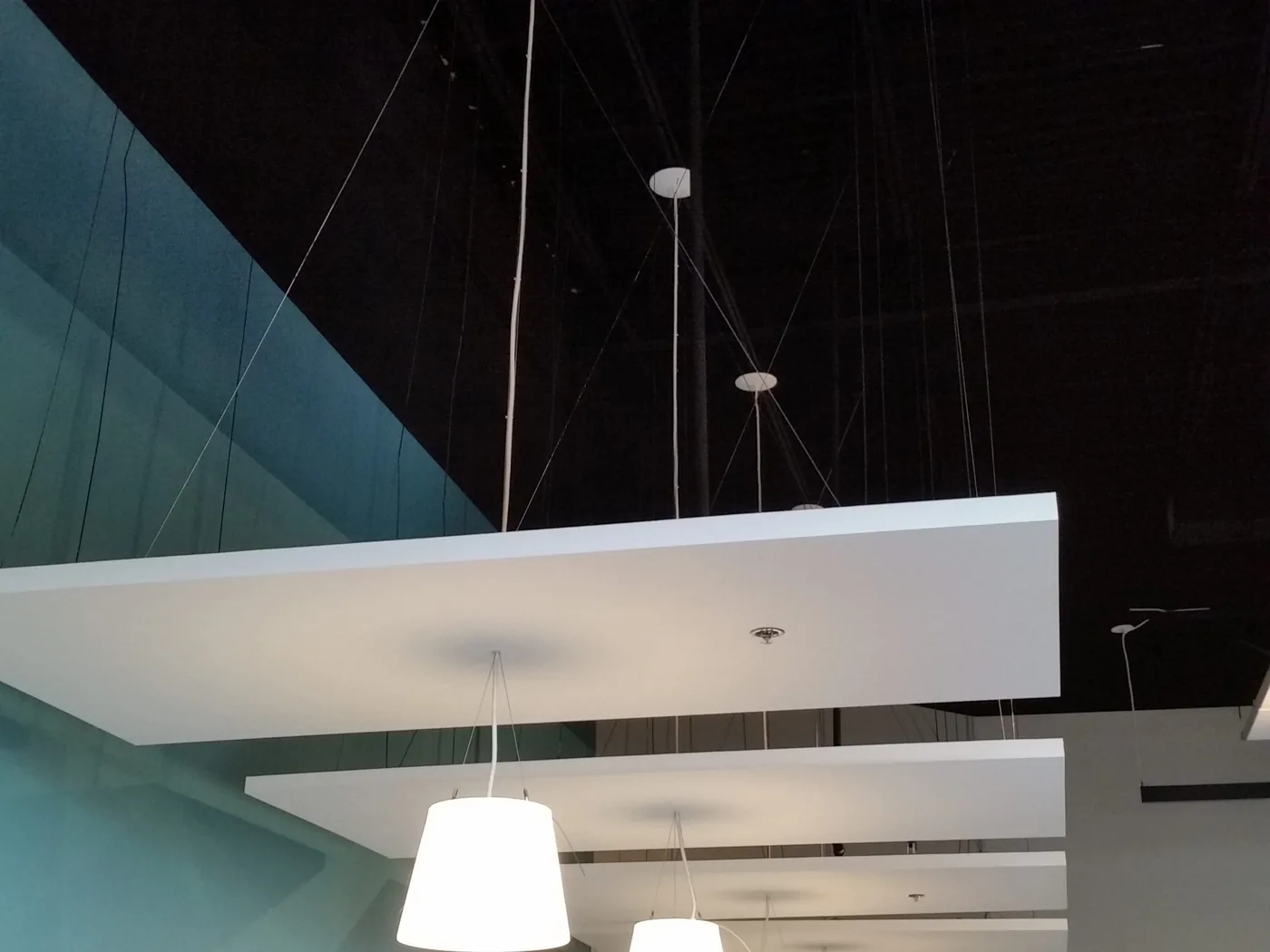
The product image shows the QTS baffle reference. The overhead project photograph provides spatial context and is not a substitute for the product mounting detail.
Configuration ledger
Panel construction, bracket, orientation and spacing all affect a suspended layout. Resolve them against the structure and building services.
Published reference6–7 PCF rigid fiberglass in one-piece or two-piece construction.
Project decisionConfirm construction, thickness and current product data.
Published referenceOne-piece: 1, 1½ or 2 inches. Back-to-back: 1¼, 1½ or 2 inches. Published maximum 48 × 120 inches.
Project decisionSelect the construction and dimensions as a matched set.
Published referenceSquare only for one-piece core. Square, bevel, miter or radius are listed on the web page for back-to-back construction; the PDF specification narrows the two-piece list to square, radius or bevel.
Project decisionConfirm the current edge options for the selected construction.
Published referenceGuilford FR701 2100 Series is listed as standard; other fabrics and perforated vinyls are referenced.
Project decisionCoordinate color, texture, fabric direction, cleanability and test applicability.
Published referenceFactory-installed QTS specialized hanging bracket. The specification assigns installation and hanging material to the contractor.
Project decisionCoordinate structure, hanger material, load path, elevation, restraint and installer scope.
Published acoustic reference
Use thickness and construction together when requesting current acoustic evidence; do not assume the same report covers every one-piece and back-to-back baffle.
Open the HB product PDF| Published thickness | Published NRC |
|---|---|
| 1 inch | 0.85 |
| 1¼ inches | 0.85 |
| 1½ inches | 0.95–1.00 |
| 2 inches | 1.00–1.05 |
The public table does not label each value by one-piece versus back-to-back test configuration. Ask for the ASTM C423 report matching the selected baffle construction and suspension.
The written source ties its ASTM E84 Class A statement to baffles with the standard fabric. Confirm current test documentation for the selected construction and finish.
Published applications
QTS publishes HB for large-volume interiors where treatment can be suspended within the room rather than confined to a wall or ceiling plane.
Documents & coordination
The HB PDF documents the two construction concepts and QTS bracket. Complete the project record with structural and installer coordination for the full suspension.
Request current project documentsThe HB web page and PDF differ in the published edge list for back-to-back construction. They also separate the factory-installed QTS bracket from contractor-supplied hanging material. Request the current assembly and suspension detail.
Record the selected construction, dimensions, finish, edge and mounting together. Request samples and current acoustic and fire-test documentation that match that assembly.
Confirm field dimensions, substrate or structure, penetrations, adjacent systems, installer scope and access requirements before fabrication or procurement.
HB questions
Use the published information to frame product review, then verify the exact assembly and evidence with QTS.
One-piece baffles use a single rigid-fiberglass core and publish square edges only. Back-to-back construction joins two wrapped cores and publishes additional edge possibilities.
The source says QTS provides a factory-installed specialized baffle bracket, while installation and hanging material are by the contractor. Confirm current scope and details.
The web page and PDF do not list exactly the same set. Request current assembly-specific product data before detailing the edge.
Yes. The product information does not replace project structural, seismic, life-safety or overhead-service coordination.
Request the report matching the selected one-piece or back-to-back construction, thickness, finish and hanging configuration.
Have an HB condition to review?
Share the room section, structure, service coordination, desired baffle layout, construction and performance criteria with QTS.