
Core
Published reference16 or 24 PCF perforated mineral fiberboard.
Project decisionConfirm which density applies to the selected thickness and performance requirement.
ACC-U-SOUND · Mineral-fiber tackable wall panel
TP is the QTS tackable-panel family built around perforated mineral fiberboard. Its construction, thickness range and published absorption values are distinct from ATP.
TP product role
The defining TP decision is its perforated mineral-fiberboard core, available in two published densities.
TP is finished in fabric or an available perforated vinyl and is offered with several edge conditions. The current sources publish absorption values for the 1/2- and 3/4-inch options, but not for the listed 1-inch panel.
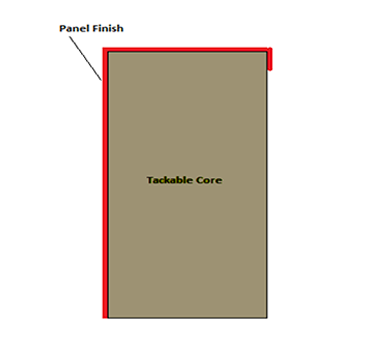
The published image is diagrammatic. Use a current physical sample to evaluate finish, edge and tack behavior.
Configuration ledger
TP has fewer published thicknesses than ATP and a different core. Keep those decisions visible through specification and submittal review.
Published reference16 or 24 PCF perforated mineral fiberboard.
Project decisionConfirm which density applies to the selected thickness and performance requirement.
Published reference1/2, 3/4 and 1 inch. The product page lists a maximum 47½ × 119½ inches; the written specification states 48 × 120 inches nominal.
Project decisionResolve the source discrepancy and record the approved panel dimensions.
Published referenceSquare, bevel, miter or radius; aluminum edges are listed for square-edge panels.
Project decisionCoordinate edge, corner detail, reveals and adjacent materials.
Published referenceGuilford FR701 2100 Series is listed as standard; other fabrics and perforated vinyls are referenced.
Project decisionConfirm tack behavior, appearance, cleanability and fire-test applicability.
Published referenceAdhesive with impaling clips and mechanical Z-clips are published. The specification also references spline.
Project decisionConfirm substrate, fasteners, level clips and installer scope.
Published acoustic reference
TP’s current product reference gives NRC values for 1/2 and 3/4 inch. No value is inferred here for the listed 1-inch option.
Open the TP product PDF| Published thickness | Published NRC |
|---|---|
| 1/2 inch | 0.30–0.40 |
| 3/4 inch | 0.55–0.60 |
| 1 inch | Not published |
Request the ASTM C423 documentation that matches the selected core density, thickness, finish and mounting. Do not assign the 3/4-inch value to a 1-inch panel by assumption.
The written source ties its ASTM E84 Class A language to panels with the standard fabric. Confirm current test documentation for the selected core, finish and assembly.
Published applications
The published TP application list spans learning, civic and workplace interiors where a usable tackable wall plane may be valuable.
Documents & coordination
The TP PDF contains useful product data but also carries a model-name error and a size difference relative to the web page. Treat it as a published reference, not a finalized project submittal.
Request current project documentsThe product page and written specification publish different nominal maximum dimensions, and the specification mistakenly names ATP in one clause. Request a corrected, current TP submittal rather than carrying either inconsistency into the project record.
Record the selected construction, dimensions, finish, edge and mounting together. Request samples and current acoustic and fire-test documentation that match that assembly.
Confirm field dimensions, substrate, penetrations, adjacent finishes, installer scope and access requirements before fabrication or procurement.
TP questions
Use the published information to frame product review, then verify the exact assembly and evidence with QTS.
QTS publishes a perforated mineral-fiberboard core at 16 or 24 PCF. Confirm the density used by the current selected assembly.
TP uses mineral fiberboard and is published in 1/2-, 3/4- and 1-inch thicknesses. ATP uses rigid fiberglass with a bonded smooth fiberglass face and a broader thickness range.
The current page and PDF do not publish an NRC value for the listed 1-inch option. Request current test data rather than inferring a value.
The web page lists 47½ × 119½ inches while the specification states 48 × 120 inches nominal. Confirm the approved dimension with QTS.
No. The published data addresses absorption and tackable surface construction, not wall STC or room-to-room isolation.
Have a TP condition to review?
Bring QTS the wall dimensions, room use, core and thickness criteria, finish direction and intended tack activity.