
Core
Published reference6–7 PCF rigid fiberglass.
Project decisionConfirm the current core and selected assembly.
ACC-U-SOUND · Corner-mounted low-frequency absorber
CBT is a fabric-finished rigid-fiberglass panel back-mitered for corner placement. Coordinate the corner geometry, thickness, size, finish and support around the room’s low-frequency criteria.
CBT product role
CBT uses a 6–7 PCF rigid-fiberglass core with back-mitered, hardened edges that bring the panel across a room corner.
The source describes a 4-inch standard thickness and a 4⅛-inch option associated with added impact resistance. The acoustic strategy should still be based on room-specific frequency behavior rather than NRC alone.
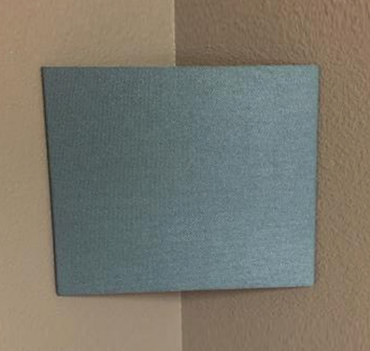
The product reference shows the intended corner condition. Confirm actual corner angle, adjacent surfaces and support before fabrication.
Configuration ledger
CBT’s geometry only works when the corner, panel dimensions and mounting are coordinated. Do not select it from NRC alone.
Published reference6–7 PCF rigid fiberglass.
Project decisionConfirm the current core and selected assembly.
Published reference4 inches; 4⅛ inches is published as an option for added impact resistance.
Project decisionChoose thickness around current test data and the corner condition.
Published referenceStandard 2 × 4 feet; custom sizes are published, with a maximum 48 × 120 inches.
Project decisionVerify current maximum, orientation, field dimensions and corner fit.
Published referenceEdges are back-mitered and chemically hardened. Guilford FR701 2100 Series is listed as standard; other fabrics and perforated vinyls are referenced.
Project decisionCoordinate corner angle, textile, color, cleanability and test applicability.
Published referenceAdhesive with impaling clips, mechanical clips, or hook-and-loop with bottom support.
Project decisionConfirm substrate, support, attachment, access and installer scope.
Published product reference
The CBT sheet reports the same NRC range for its two listed thicknesses. Request current test information and room-specific guidance where frequency behavior matters.
Open the CBT product PDF| Published thickness | Published NRC |
|---|---|
| 4 inches | 1.05–1.10 |
| 4⅛ inches | 1.05–1.10 |
NRC is a single-number absorption average. It does not show the product’s absorption by frequency or predict room modes, decay, isolation or placement quantity.
The product sheet states an ASTM E84 tunnel-test result below 25 / Class A or I. Confirm current documentation for the exact fabric, thickness and assembly.
Published applications
QTS publishes CBT for music, production and playback environments. The exact placement and quantity should follow the room’s measured or designed condition.
Documents & coordination
The concise CBT product sheet should be supplemented with current frequency-specific evidence, finish data and mounting information when required by the project.
Request current project documentsThe current CBT PDF is a one-page product sheet. It publishes NRC values but no frequency-by-frequency absorption data, room-mode model or isolation rating. Use project-specific acoustic criteria for low-frequency selection.
Record the selected construction, dimensions, finish and mounting together. Request current acoustic, fire and installation evidence that matches that assembly.
Confirm field dimensions, substrate or structure, penetrations, adjacent systems, installer scope and access requirements before fabrication or procurement.
CBT questions
Use the published information to frame product review, then verify the exact assembly and evidence with QTS.
The published edges are back-mitered so the panel spans the corner as a decorative and functional absorber. Confirm the actual corner angle and support.
No. NRC is a broad average and does not show absorption by frequency. Request the evidence and acoustic analysis required for the room.
The source lists both with the same NRC range and describes the 4⅛-inch option as providing added impact resistance. Confirm the current construction.
The source says custom sizes are available and lists a maximum 48 × 120 inches. Verify the exact corner geometry and current fabrication limit.
The source describes absorption within the room, not sound isolation through the building envelope. Isolation requires evaluation of the complete construction.
Have a CBT condition to review?
Share the room geometry, acoustic criteria, corner measurements, finish intent and mounting substrate with QTS.